
 Sample selections
... for guitar
Sample selections
... for guitar
Regardless of modern guitar, 19th century guitar, or even
other stringed instruments, there is some instruments that sound
better (with rather subjective judgment in volume and fullness of
tone, though) when it is tuned a half or one full tone lower. While
winding up a string after changing it, you may notice a few points
where the instrument resonates better. That's the "good sounding"
point.
You will have to wind the string a little further to have it tuned.
It must be very rare to have all the strings resonate well after
tuning properly. Unfortunately, it usually passed the resonating
point and stresses the instruments unnecessarily when it's tuned. If
you are playing solo and there is no need to match with others, you
can use the "good sounding" point for your instrument. It's not
always necessary to tune the instrument with A=440Hz. You should use
the good sounding pitch and strings without damaging the instrument
and enjoy it.
Almost any strings in thickness and of material available can be
obtained in Japan. They are so wide variety of them that one may
mistake guitars are made for them in these days. If you feel your
instrument does not sound right, you'd better try other strings
without hesitation. String tension listed below are either from their
package or from some publications in the past. I added some
explanations on them.
Caution : String tension would
have an error depending on scale length, structures of bridge and
neck, and the standard pitch used. Please regard the following as a
rough guide.
 People often say that Augustine Black is
lighter tension. How light it is then, I would ask. I summarize total
tension I found in one of magazines below. Their tension seem to be
set to around 40 kg.
People often say that Augustine Black is
lighter tension. How light it is then, I would ask. I summarize total
tension I found in one of magazines below. Their tension seem to be
set to around 40 kg.Red : 42.5 kg/set
Blue : 42.0 kg/set
Black : 39.1 kg/set
Strings made of nylon and fluorocarbon can be substitute with fishing lines and their tension can be calculated with the string slide rule. However, the same cannot be done for bass strings which usually are metal wound strings and need to be supplied by string manufacturers. According to a tension measurement result in an article I found on a Japanese guitar publication, tension of bass strings of various manufacturer for modern classical guitars are, 4th: Yamaha Grand Concert 5.7kg, 5th: Augustine Black 6.35kg and Savarez Redcard High tension RE-D5 6.3kg, and 6th: Yamaha Classic Guitar String 5.9kg and Augustine Black 6.3kg. Savarez Redcard is relatively low tension, 4th: 7.3kg, 5th 6.3kg, and 6th: 6.7kg, despite of the fact that the package claims "high tension". In any events, tension per string generally exceeds 6kg. Some of the result published in the article I mentioned above seem to contradict with the numbers made public by manufacturers. So, you should take these numbers just as a rough guide.
Hannabach made tension of their strings public on their web site listed below. They are supplying strings at about 2kg increment in total tension.
http://www.hannabach-strings.com/index_nav.htm
Red label (SuperHighTension) : Total 45.4 daN (about 46.3kg)
Blue label (HighTension) : Total 44.3daN (about 45.2kg)
Diff. label (Medium High Tension): Total 43.1daN (about 44kg)
Black label (Medium Tension) : Total 41.1daN (about 42kg)
Green label (Low Tension) : Total 39.7daN (about 40.5kg)
Yellow label (Super Low Tension) : Total 37.0daN (about 37.7kg)
As you can see in Hannabach's products, stringed instruments like guitar change their characteristics like volume, sound, or touch greatly by changing tension by about 300g. Typically, a half tone change in tuning of a string causes its tension to change about 500g, so the change in total tension would be 3kg.
Many string manufacturers have adopted higher tension on 1st string compared to the others in order to make it sound louder and make a melody line clearer.
In the following, I will explain
details on how to select strings based on its material and
tension.|
|
You can substitute treble strings with fishing lines, but how about bass strings.
The string tension of ProArte hard tension is shown below. Total tension can be calculated to be 39.59kg, which is about 40kg and 6.6kg/string in average. By the way, the scale length ProArte uses as a standard is 648mm, according to its package. It should be noted that 1st and 4th string have a slightly higher tension than others.
[ProArte Hard Tension]

1st : 7.17kg, Nylon 0.74mm
2nd : 5.44kg, Nylon 0.85mm
3rd : 5.62kg, Nylon 1.04mm
4th : 7.44kg, Metal wound 0.76mm (equivalent to VN5145)
5th : 7.21kg, Metal wound 0.91mm (equivalent to VN5190)
6th : 6.60kg, Metal wound 1.12mm (equivalent to VN5240)
Now, the following shows tension of ProArte light tension strings.
Although it often sounds rather thin on some modern guitars, it is
still popular among women and those who lack grip strength. A certain
type of modern guitar may have a good match with this string. When
the entire set is used, the total tension is 35.43kg, according to the information on
its package, and per string tension will be about 5.9kg. Thicker than other strings' gauge
is used on 1st and 4th string.
You may think "I can use this one on a 19th century guitar as
is." As a matter of fact, I have been using them on some 19th
century guitars. If I force myself to find a weakness of this
combination, bass strings tend to sound rather dull. 4th
through 6th string of this set is silver plated wire wound over nylon
strands. I have tried this string on genuine 19th century guitars of
different types and scale lengths. My conclusion is that "it depends on the instrument." There is
an individual difference even among the instruments of exactly the
same type. So, it's better actually to try a few strings on the
instrument and this ProArte light tension can be one of the
candidates, because of their wide availability and low cost. It's
also OK to use fishing lines on 1st through 3rd and ProArte on 4th
through 6th.
[ProArte Light Tension]

1st : 6.7kg, Nylon 0.71mm
2nd : 5.08kg, Nylon 0.81mm
3rd : 5.3kg, Nylon 1.02mm
4th : 6.7kg, Metal wound 0.71mm (equivalent to VN5136)
5th : 5.67kg, Metal wound 0.84mm (equivalent to VN5165)
6th : 5.98kg, Metal wound 1.07mm (equivalent to VN5230)
19th century guitars having only horizontal bracing bars may not
sound right with ProArte light tension, especially metal wound
strings. I have tried them on short scale length (560 - 610mm) ones,
but I felt it better to lower the tension down to like 4kg/string in
order to get better results on sound and playability. Some people
wrote a lengthy review on magazines, but I think relying on them is
waste of time and it's best to find out by using on your own
instrument. Yes, you got to find a good match between strings and the
instruments.
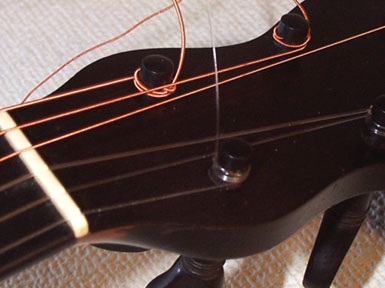
The photo below has been taken while trying Seaguar Ace for treble
and Kuerschner's copper wound strings for bass. The guitar is made in
France around 1920 and quite similar in a configuration of bracing
bars, a detailed structure, and its parts to what Lacote made then.
It sounded great with the average tension of about 5kg.
|
|
For strings of lute, baroque guitar, 19th century guitar, and ukulele, nylon and fluorocarbon are widely used. Alternatively, one can use fishing lines for most of them. By the way, Savarez makes plastic wound treble strings.
If you want to use fluorocarbon for treble strings, you can use Seaguar series mentioned below especially for guitars. Even guitar strings sold in music shops seem to be produced by fishing line makers. You can use the following among Seaguar Ace. When you are to try new strings, you may want to change sound of an instrument a little without changing tension. In this case, please refer to the sections of "Fishing line gauge" and "References". Obviously, string slide rule is very useful doing this!
|
If you want to use a nylon string instead of
fluorocarbon, multiply the thickness by a factor of 1.3. |
Select
strings with knowing their tension![ProArte hard tension: total tension 39.59kg / 6.6kg in average]
If you are using a modern classical guitar and want to change treble strings to fluorocarbon, the following are the candidates. By the way, metal wound strings by Kuerschner (VN series) are listed for bass ones.
1st : 7.17kg, Nylon 0.74mm, equivalent fluorocarbon is 0.57mm
(12 gauge). Gut : 0.62mm
2nd : 5.44kg, Nylon 0.85mm, equivalent fluorocarbon is 0.66mm (16
gauge). Gut : 0.73mm
3rd : 5.62kg, Nylon 1.04mm, equivalent fluorocarbon is 0.81mm (24
gauge). Gut : 0.91mm
4th : 7.55kg, metal wound 0.76mm (equivalent to VN5145)
5th : 7.21kg, metal wound 0.91mm (equivalent to VN5185)
6th : 6.60kg, metal wound 1.12mm (equivalent to VN5250)
[ProArte Light Tension: total tension about 35.43kg / 5.9kg in average]
If you are to replace treble ones with fluorocarbon,
1st : 6.7kg, Nylon 0.71mm, equivalent fluorocarbon is 0.55mm (11
gauge?) Gut : 0.60mm
2nd : 5.08kg, Nylon 0.81mm, equivalent fluorocarbon is 0.63mm (15
gauge?) Gut : 0.70mm
3rd : 5.3kg, Nylon 1.02mm, equivalent fluorocarbon is 0.79mm (22
gauge?) Gut : 0.88mm
4th : 6.7kg, metal wound 0.71mm (equivalent to VN5136)
5th : 5.67kg, metal wound 0.84mm (equivalent to VN5165)
6th : 5.98kg, metal wound 1.07mm (equivalent to VN5230)
Fishing lines are available only on some discrete gauge (thickness).
So, the following show a sample using available gauge lines at a
typical fishing supply store.
1st : Seaguar Ace 10 gauge
2nd : Seaguar Ace 14 gauge
3rd : Seaguar Ace 20 gauge
You may say "I will go to a fishing supply shop
right away and buy some lines", but wait. Fluorocarbon strings, well
finishing lines actually, are not cheap, especially thick gauge ones.
There is not much demand on thick gauge lines in the fishing world
and a 50m reel of 16 gauge line costs 5,200 yen (about $50.) in a
suggested retail price, for example. Purchasing unnecessary lines
makes a large hole in your purse, even though you usually find ones
in a discount price. I have to tell that the relation between tension
and sound is extremely subtle, which you will notice while trying by
yourself. It will take a rather long time and trouble to find a proper
string when you substitute it with fishing line, because you have to
go through many iterations of trial and error.
Fluorocarbon string sounds relatively metallic compared to nylon or
gut strings due to its high density. I've heard sound of a fork
guitar (namely steel string acoustic guitar) whose 1st string has
been replaced with a fluorocarbon. It sounded close to a steel string
and very natural. Many of those who listened my "concept-2", cittern
like ebony instrument, think it being steel stringed, although it
actually uses fluorocarbon. So, a fluorocarbon string should be
regarded as a replacement for nylon on some instruments, but not all.
As of fall 2004, I often use nylon fishing line for 1st and
fluorocarbon on 2nd and 3rd strings of 19th century guitars. 3rd
string tends to sound firmer and codes played on them sound clearer
by doing so. On the 1st string, nylon line tends to have a better
result, because fluorocarbon one sometimes sounds too metallic.
Music shops might have a hard time of selling strings after making
these informations public. They might complain about that and sue me.
They might even hire men to force me to wear concrete boots and dive
into the Tokyo bay. Hum, this is rather chilling thoughts. All of you ought to buy strings at the nearest music
stores to prevent this to happen!! Even though providing
these information, I buy strings from music shops quite often.
|
|
Is there more convenient way?", some may ask to select string with lie tension. I have an idea for those, which is using strings for alto guitars. You may not have seen them often, but you can be lucky to find one or mail order them. If your instrument's scale length is appropriate, you may be able to use strings for children guitars or Yamaha's guitalele strings.
[ProArte Alto guitar string]
Treble strings are not made of nylon, but something in between nylon and fluorocarbon both in weight and stiffness. Bass strings are similar to regular ProArte, namely relatively heavy and thin. Tension seemed not to be uniform and 1st one is rather high tension (I think this should be substituted with fishing line).

[ProArte J52 Alto Guitar set] Scale length: 540mm, Pitch A=440Hz
1st : unknown material 0.64mm (9.12kg)
2nd : unknown material, no mention of diameter nor tension
3rd : unknown material, no mention of diameter nor tension
4th : AltoGuitar Silverplated Wound, no mention of diameter nor tension
5th : AltoGuitar Silverplated Wound, no mention of diameter nor tension
6th : AltoGuitar Silverplated Wound, no mention of diameter nor tension
I summarized tension of this "ProArte Alto Guitar" string set used on 19th century guitar with a scale length of 620mm. I measured weight and length of the strings, made a tension table, and tried on a few instruments. As you can see below, they are relatively low tension except for the 1st. So, you can use them on some instruments.
[ProArte J52 Alto Guitar set] Scale Length: 620mm, Pitch A=440Hz
1st : hard nylon 0.63mm 0.34g (7.0kg), equivalent to 0.70mm nylon
2nd : hard nylon 0.72mm 0.45g (4.8kg), equivalent to 0.76mm nylon
3rd : hard nylon 0.82mm 0.57g (3.8kg), equivalent to 0.86mm nylon
4th : 1.34g (about 4kg)
5th : 2.20g (about 4kg)
6th : 3.42g (about 4kg)
[A set of strings specific for Pepe guitar]
Have you heard of Pepe series guitars? It's a small scale length
guitar for children produced and distributed by Aria Co. They have
several scale lengths of them and also produce strings and cases
specifically for Pepe guitars. They can be found in specialty shops
of guitars or in on-line shops that accept orders from international
orders. 1st and 2nd strings are nylon and others are thin metal wound
ones. In general, they are thin gauge and light tension set. However,
I have not measured their tension accurately, yet.

[Hannabach Alto Guitar]
This is harder tensioned than ProArte's. I do not recommend them
because they are expensive, but you can find some instruments that
may fit to it.
return to index
