
 Sample selections
... for Ukulele
Sample selections
... for Ukulele
The Crane web site features mainly guitars, lutes, and ukuleles.
So, we have to have a section of ukulele in this string corner. Among
ukuleles, there is various types like 8 stringed, resonator, short
scale length, long scale length, and even specially made ones. I will
concentrate on soprano ukulele here, for I don't have enough space
and time to deal with all the types.
[Soprano (standard) tuning]
g,c1,e1,a1/g1,c1,e1,a1/a1,d1,f1#,b1/a,d1,f1#,b1
[Concert tuning] g,c1,e1,a1/g1,c1,e1,a1
[Tenor tuning] G,c,e,a/g,c,e,a/g,c1,e1,a1/g1,c1,e1,a1
[Baritone tuning] D,G,B,e
[Others] Others, like 8 string uke etc.,
are omitted here.
 You will not have a hard time to find ukulele
strings, because there are so many of them available. It's also
possible to use some of guitar strings on ukuleles. But, I'm using
Seaguar on three ukuleles I own. As explained in "Hyper music class
for Ukulele", Seaguar is used for 1st through 3rd and a guitar string
is used on 4th (d). For the 4th, I like to use light tension metal
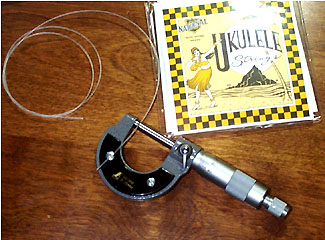
wound string for 4th on guitar. Photo below shows how I measure .....
Well, have you measured a scale length of ukulele? Its string
diameters? I have to wonder whether I should be this serious on
ukulele or not.
You will not have a hard time to find ukulele
strings, because there are so many of them available. It's also
possible to use some of guitar strings on ukuleles. But, I'm using
Seaguar on three ukuleles I own. As explained in "Hyper music class
for Ukulele", Seaguar is used for 1st through 3rd and a guitar string
is used on 4th (d). For the 4th, I like to use light tension metal
wound string for 4th on guitar. Photo below shows how I measure .....
Well, have you measured a scale length of ukulele? Its string
diameters? I have to wonder whether I should be this serious on
ukulele or not.
The difference among the ukulele strings I often
see at the shops are listed below. As expected, strings for soprano and concert ones usually are the
same at many music stores. Namely, you will get either
(1), (2), or (3) at a music store, when you ask
a set of strings for ukulele. Fine, that's fine for ukulele.
Which means that "The same string set should be used for any of (1), (2), or (3)". Strings made by ghs go even further and say "this set can be used on soprano, concert, and tenor ukuleles." Well, these have almost an octave difference among them.
Fine, that's fine for ukulele
(1) a1,d1,f1#,b1: a regular set for soprano uke's in a soprano
tuning.
(M600 by
Martin, etc.)
(2) g1,c1,e1,a1: a set for soprano uke's in a concert
tuning.
(Standard Set by Hilo Strings, etc.)
(3) g1,c1,e1,a1: a set for concert uke's
(Concert set by Hilo Strings, etc.)
(4) g,c1,e1,a1: Low G set for soprano or concert uke's.
(STANDARD &
CONCERT-LOW G by Kamaka, etc.)
(5) g,c,e,a: a set for tenor uke's.
(6) G,c,e,a: Low G set for tenor uke's.
(7) d,G,B,e: a set for baritone uke's
(8) individual string for low G 4th: (a few found are using
strings for guitars)
|
|
There should be very little problem on using this set for a concert ukulele or with (2) tuning. Ukulele is an instrument with 4 single strings and there is little chance of a casual string selection causing damage on it, like cracks on the sound board. However, it is preferable to know how much tension the instrument is in and how the string selection makes a difference on its sounds. The soprano set taken as an example here is M600 by Martin. String gauge and tuning are noted on the package of each strings. So, their tension and equivalent fluorocarbon ones can be calculated based on the information. Some string sets use an average tension of as high as 3.8kg (15kg per set!).
A=440Hz, scale length 340mm, approx. 12.1kg/set
1st b1: 2.7kg, nylon 0.53mm or
fluorocarbon 0.41mm (6gauge)
2nd f1#: 3.5kg, nylon 0.81mm or
fluorocarbon 0.62mm (14 gauge)
3rd d1 : 2.8kg, nylon 0.91mm or
fluorocarbon 0.70mm (18gauge)
4th a1 : 3.1kg, nylon 0.64mm or
fluorocarbon 0.493mm (8/10 gauge)
4th a: ProArte LightTension 4th :
metal wound 0.71mm
4th a: ProArte Hardtension 4th :
metal wound 0.76mm
Now, tension of the strings are calculated in case this soprano
strings are directly used on concert uke's (assuming 400mm scale
length, relatively long among various length). If the instrument is
tuned a1, d1, f1#, and b1, the tension becomes higher. Due to
the longer scale length, tension would be a little higher even with
g1,c1,e1,a1 tuning. It will be even higher if metal wound
string is used on 4th. Actually the total tension might be similar
(about 12 kg) on concert uke's whose scale length is 360mm or 380mm.
That's why the string can be shared among the different uke's.
Because higher tension makes strings easier to go off tune, I tend to
recommend (2) set to beginners when they are to use concert uke's.
However, the strings they got the next day occasionally were ones
specific for soprano uke's. Some shop personal did not have an idea
on the difference. Fine that's fine for ukuleles.
A=440Hz, scale length 400mm, total tension about 13.2kg
1st a1: 2.9kg, Nylon
0.53mm
2nd e1: 3.8kg, Nylon 0.81mm
3rd c1: 3.1kg, Nylon 0.91mm
4th g1: 3.4kg, Nylon 0.64mm
|
|
Now, let's measure tension of the Standard Set by Hilo Strings. There might be a small error, due to them being a set of black nylon strings. Their package do not mention anything on tension or diameter of the strings and note only "which string this one is for". So, I have to measure the diameter of the strings with a micrometer, calculate their tension from the thickness, and find an equivalent fluorocarbon ones.
A=440Hz, scale length 340mm
1st a1: 3.2kg, Nylon 0.65mm or fluorocarbon 0.52mm (10 gauge)
2nd e1: 2.9kg, Nylon 0.83mm or fluorocarbon 0.66mm (16 gauge)
3rd c1: 2.6kg, Nylon 0.98mm or fluorocarbon 0.74mm (20 gauge)
4th g1: 3.0kg, Nylon 0.70mm or fluorocarbon 0.57mm (12 gauge)
(ProArte Light Tension for 4th: metal wound 0.71mm)
(ProArte Hard Tension for 4th: metal wound 0.76mm)
By the way, Mr Koichiro Tashiro, a professional ukulele player, told
me that he is using the following Seaguar set on his. His soprano
ukulele "style 1" by Martin, whose scale length is 348mm, is posted
on his web site, Tassi Home Page. Professionals rarely reveal
what they actually use on their instruments. So, I will post this
with a lot of thanks to him. A combination of 8, 14, and 20 gauge
actually is the one I use most often on 19th century guitars.
|
Tassi set (for soprano featuring Seaguar) 1st: 0.47mm, 8 gauge Use ProArte hard tension 4th for low G tuning. |
Extra: Proper way to buy ukulele strings.
(1) Go to any music store.
(2) Find a sales lady.
(3) Tell her "I want ukulele strings."
The important thing is, even when she asks an unexpected question
like "Would you like low G?", you should just tell her "I want
ukulele strings." without showing any hesitation. You should never
discuss about the details and tell her "I want ukulele strings."
repeatedly.
(4) In case she insists to know exactly what kind of strings you
want, you should tell in serious and slightly louder voice "I want
regular ukulele strings."
Fine, this is perfectly fine for ukulele.
