
 About Gut
string
About Gut
string
 Gut string
is made of sheep gut, which is the small intestine of sheep cleaned
of any content and made to be thin skinned tube. If you fill this
with some meat, you will come up with sausages. If you stretch and
twist this, you can make strings. How exactly to make a gut string
often guarded as a secret and details on the production process are
hard to find in references. In any event, there are a few
manufacturers and distributors of gut strings available at
present.
Gut string
is made of sheep gut, which is the small intestine of sheep cleaned
of any content and made to be thin skinned tube. If you fill this
with some meat, you will come up with sausages. If you stretch and
twist this, you can make strings. How exactly to make a gut string
often guarded as a secret and details on the production process are
hard to find in references. In any event, there are a few
manufacturers and distributors of gut strings available at
present.
Gut strings are distributed by Aquila in Italy,
Savarez, EMS (Early Music Shop brand), Kuershner, NRI, and Pyramid
among others. In Japan, Guitarra (Tokyo Early Instruments Center) is
selling gut strings and strings for lute. In recent years, more shops
are selling gut string in mail order. I usually purchased gut strings
by importing them personally.
There is higher density gut strings like high twist ones or others
specially treated in the production process. On the other hand there
are gut strings used for frets of baroque guitar or lute, which are
sold as "fret gut" and seem lightly twisted ones.
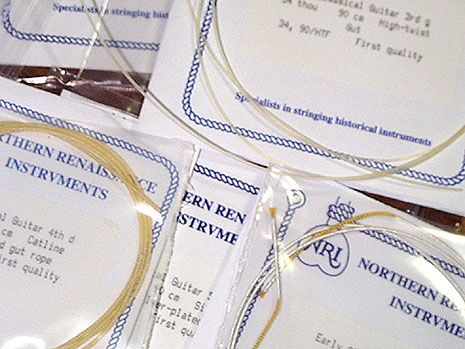
Photo below shows a set of strings for a 19th century guitar I
obtained from NRI of England. 1st and 2nd are low twisted and ground
strings. 3rd string is high twisted and ground one. 4th alone is so
called "catline", which is a gut string twisted like a rope. 5th and
6th are silver plated copper wire wound over silk. Their thicknesses
are,
e': 22.5thou
b: 27thou
g: 34thou
d: 45thou
A: 60thou
E: 80thou
Unit "thou" used above means a thousandths of an inch. One inch is
25.4 mm, so multiplying these numbers by 25.4 then dividing by 1000
will give the thickness in mm. 22.5 times 25.4 is 571.5, therefore
the 1st string thickness is 0.5715 mm. Doing the same math for the
other strings and one can get 2nd: 0.6858 mm, 3rd: 0.8636 mm, 4th:
1.142 mm, 5th: 1.524 mm, and 6th: 2.032 mm.
By the way, a name "catline" seems to originate from a rope used to
moor a ship's anchor. This 4th string is a rope like one with 3 gut
strands twisted together. In a photo below, 3rd, 4th and 5th strings
are shown.
Thanks to the Internet, very deep
strings like strand twisted gut and silver wire wound gut strings can
be obtained rather easily these days. Personally, I use Pyramid's or Kuershner's
partly because they make string slide
rules.
The popularity of nylon guitar string has started
in the era of Segovia after the WW-II and gut strings had been the
string on guitars before. Although they are little more expensive,
please try the gut strings, too. I sometimes use gut strings and they
don't last long. Actually, people tend to think the sound of used gut
strings without higher harmonics favorably. 19th century guitars
sometimes change their sound greatly when the strings are changed to
gut. But for those who accustomed with the sound of steel string and
modern classical guitars, the sound of gut string may be felt lacking
brightness.
There is two different finish used on gut
strings. One is varnish primarily for plucking instruments and the
other is oil for bowed instruments. Some string makers distribute
finishing varnish, also. Pyramid sells oil for gut strings.
Players of early string instruments do not change
strings often. It's not unheard of that some professional players
change only once a year or two years. Broken in strings may be felt
right on fingers? On the other hand, modern classical guitar players
often change the string once a week or professionals sometimes change
them every stage. While I was a student, I used to use them till they
broke. Even these days, I change string very rarely (is this because
I practice rarely?).
return to index
