Things to consider
in selecting strings
Things to consider
in selecting strings
 Scale length : At the same pitch, longer the
scale length higher the tension is and vise versa.
Scale length : At the same pitch, longer the
scale length higher the tension is and vise versa.
The scale length of many 19th century guitars are around 620mm,
while that of most modern classical guitars are 650mm or longer. The
latter use the resulting higher tension to increase volume,
projection, and sustain of the instruments. Ramirez has a 664mm
model, for example. Modern classical guitars tend to have deeper
bodies and larger sound board area in recent years. It is my personal
impression that an use of a slant bracing bar by Ramirez is meant
more to withstand higher tension than to get better sound
characteristics. By the way, a bracing scheme using a slant bar can
be seen on many guitars besides Ramirez', though Jose seemed to have
acquired a patent on it. Instruments that use multiple steel strings
per course, like Gibson's mandolins and so called 12 string fork
guitars, should be under extremely high tension. Strings by Gibson in
average seem to be in a slightly higher tension than others.
String angle at saddle
and nut : You have to be careful on the angle at the
point where the strings are supported. Larger the bending angle of
the string at saddle, greater the force exerted onto the sound board
(or vise versa) becomes. Higher the string tension, more the volume
tends to be generated by an instrument. At the same time, more force
is needed to hold down the strings by left hand and to play them by
right hand. A luthier told me that a 19th century guitar (he was
talking about French style instrument) would be certainly damaged
when tension of 8kg/string were used like modern classical guitars.
It seemed better for a 19th century guitar to strung with a tension
of 4~6 kg/string and to adjust such a way that it responds slight
touch of both hands. You are to play an instrument that was used with
high tension at the period, though, you have to string it
accordingly. It often is the case that the appropriate tension of
instruments depends on their type (locality, period, and structure),
even when the scale lengths are the same.
Because shorter scale length results lower tension, there seems to be
little problem using modern classical guitar strings with a typical
scale length of 650mm on a 19th century guitar of 630mm. But, the
strings seem to be too thick and tension feels rather high, if this
is attempted. Many 19th century guitars use pins to affix strings at
the bridge and higher saddle, which apply more pressure on the sound
board than modern guitar with the same string tension. You have to be
careful about the angle at the saddle.
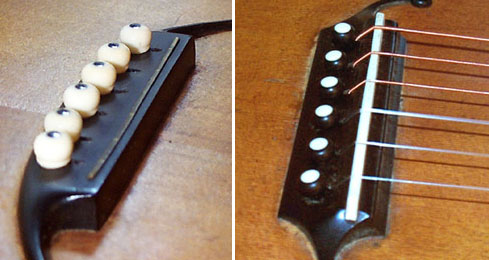
The following two pictures show bridges of two 19th century guitars
which are unaltered and in an original condition. I took these while
adjusting saddles in repairing processes. The guitar on left has not
much string bending at the saddle and one on right has a higher
saddle which makes the bending angle larger. These are the
differences that existed at the time they were made.
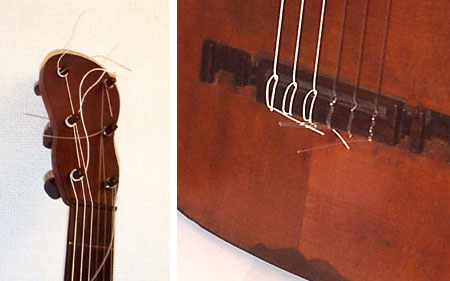
The next photo shows Spanish (or Portuguese) guitar made around 1820.
The photo was taken while changing strings after a repair. A part of
bridge structure acts as a saddle, therefore the saddle height and
string angle at the saddle changes as the bridge wares down. Tension
also should change slightly. It is quite similar to the bridge of
modern classical guitars.
Bracing scheme :
instruments with fan bracing seem to sound better with higher
tension.
Many modern guitars adopt a fan bracing scheme, but 19th century
guitars tend to use a few parallel bars. Some say that instruments
with fan bracing by Panormo seem to sound better with relatively high
tension. But, Panormo made a variety of instruments and there remains
a few of his having a very thin sound board. I would say that it
depends on the individual instrument. There exists some instruments
with fan bracing scheme originated from Panormo that sound better
with lower tension. Many recent classical and steel string guitars
are made with complex bracing schemes, like Kasha bracing, which tend
to be designed to withstand more tension. The body size tends to
become larger with larger sound board area and thicker body.
Density of string
: Heavier strings tend to generate low tone and lighter ones
high.
Metal wound, fluorocarbon, gut, and nylon are typical string
material in an order of density (high to low). One can use
fluorocarbon lines sold as " Seaguer" from Kureha chemical in
fishing supply shops. Nylon fishing lines can also be used on
stringed instruments if they are proper gauge ones. Gut strings can
be found at music shops specialized in early string instruments.
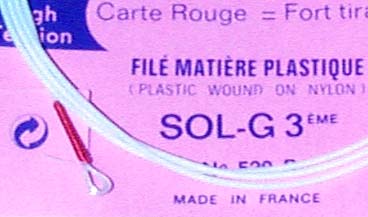
Ground nylon strings and
plastic wound strings for treble are sold by Savarez and
others. ProArte by D'Addario and Augustine strings are popular among
modern classical guitar players. Hannabach seems to use a different
scale on string tension and their "normal tension" seems to be harder
than some "hard tension" ones of other companies. As special cases to
increase string density, there are twisted multiple gut strings,
metal wire wound over gut strings, metal powder doped gut strings,
etc. You can also find metal salt loaded gut strings distributed by
early string makers. Among gut strings, those with extra twist to
increase density are called "high twist". Among ukulele strings,
there is a set of all wound strings for Dobro uku's.
Tuning pitch
: Modern pitch is A=440Hz, but the standard pitch used in 19th
century was A=430Hz (1/4 tone lower) or
A=435Hz.
I used to use Hannabach's "Super low tension" in A=415Hz,
because this is exactly a half tone lower than modern pitch. But,
this tuning is not practical to play in an ensemble. Currently, I
usually use strings for early instruments in 440 Hz. It's common to
use A=440Hz and better to select strings for that pitch in an
ensemble. For an audience with an absolute pitch, it may be hard to
listen other than 440 Hz ;-P.
Playing with nail or
finger tip : It is preferable to use higher tension for
playing with nail and lower tension with finger tip.
This summarizes the tendency of many people's observations.
Though, it's not an easy problem to answer, because personal
preferences take a large part in judging playability, sound, and
volume of an instrument. Personally, I use very short nail for
playing single string (19th century, modern classical, or flamenco)
and double string guitars, ukuleles, and steel string instruments,
though not skilled enough to change touch depending on the
instrument. Even period lute players had played either with nail or
finger tip. Some references claim that lutenists do not use nail, but
this is not true. However, finger tip playing may have some
advantages on playing double stringed instruments.
1st string (course)
tends to stretch easily : this is especially true for thin
gauge nylon.
It seems better to use slightly thicker gauge string for 1st one
than required. There is a side effect of a melody line being clearer
with this.