
 how to use string
slide rule (# 2)
how to use string
slide rule (# 2)
|
|
 Scale length, standard
pitch, and tension are the important parameter.
Scale length, standard
pitch, and tension are the important parameter.Scale length, standard pitch, and tension are the points
This section is describing how to use Kuerschner's string slide rule. The detailed explanations will follow. It is another deep subject, so you have to dig deeper into your brain and read carefully.
How to operate Kuerschner's slide rule is quite similar to Pyramid's. However, Kuerschner's has an instruction only in German and it might be easier to understand to have translations of words used on it.
The following are English translation of German words used on the Kuerschner's string slide rule.
saiten: string
 phi: (phi)
thickness of the string, diameter.
phi: (phi)
thickness of the string, diameter.
aquivalenter: translated (equivalent).
Mensur: scale length.
Saitenkraft: string tension in an unit of Newton (N).
Fluor-Carbon(PVF): Fluorocarbon, namely "Seaguer" and others in
fishing lines.
Nylon (NR): Nylon, namely treble strings in an usual guitar string
set.
Stahl: stainless steel.
Darm: gut.
Nylgut(PE): Nylgut (nylon string similar to gut in its
characteristics).
Kupfer: copper.
versilbert: plated.
By the way, it indicates lighter and harder tension scales along with
the normal one, which are very useful.
extra leicht: extra light
leicht: light
(none marked): normal tension
stark: hard, strong
extra stark: harder, stronger
As you can see, it's a plastic sheet with two rules, one narrow
and the other wide, inserted. There are many scales printed on the
main sheet. You can choose appropriate strings of any material
(nylon, fluorocarbon, gut, or metal wound), any scale length, and any
tension. This gotta be a good stuff.
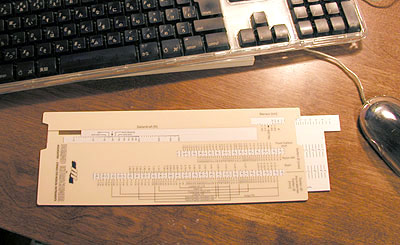
(1) First, you hold it in portrait, namely in a position where the
rule can be pulled out to top.
Let's decide the standard pitch, namely deciding the frequency of A
(like 440 Hz or 415 Hz). Then take three deep breaths.
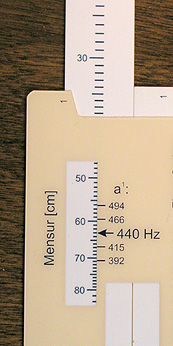
I will use A=440 Hz in the following explanations. The word "Mensur"
written on top left is the scale length, the length between the nut
and saddle. Take a 19th century guitar with a scale length of 63 cm
as an example, then adjust the narrow rule to match scale length 63
(cm) to an arrow indicating 440 Hz as shown in the following
photo.
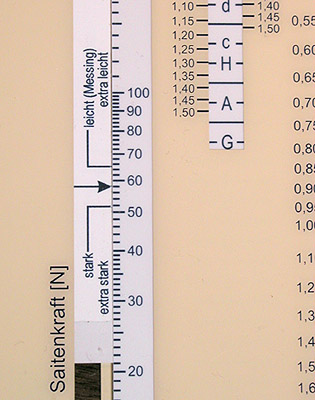
(2) Determine the string tension in an unit of force, Newton (1kg =
2.2 lb = 9.8N). Pull up the right side wider rule to match the proper
tension value, while keeping the left one in the same place. For
example, if you want to use a tension of 5.8kg (13 lb), adjust
the wide rule to align 57 on the scale to the arrow on the tension.
This also is show in the following photo.
(3) Let's find the 1st sting, first. Only thing you have to do is to
read the scale without moving two rules on it. For example, 1st
string of guitar is expressed like e' or e1 in an
absolute tone scale. So, take a look at e1 on the scale. You
may notice that there is numbers written on the both side of the
scale and wonder which side you should use. In this slide rule, you
should use one number or the other depending on the material of the
string you are planning to use.
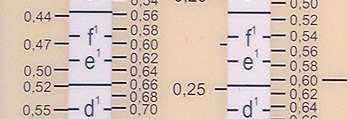
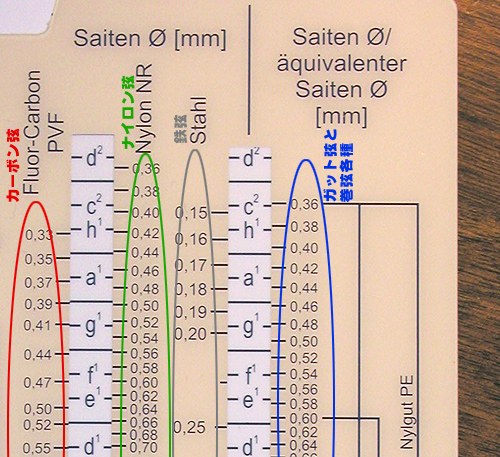
As you can see in a photo below, an e1 string thickness in
5.8kg tension can be found in different material
(fluorocarbon, gut, nylon, and metal wound from left to right) The
thicknesses it indicates are 0.50mm for
fluorocarbon, 0.58mm for
gut, and 0.62mm for
nylon. By the way, if you want a steel string, the
thickness you need is approximately 0.25mm. You can't choose any thickness in
strings, unfortunately. So, you have to choose something close to the
indicated thickness.
Darmsaiten: Gut
Fluor-Carbon PVFÄF fluorocarbon (like "Seaguer" in
fishing lines)
Nylon: Nylon (regular fishing lines)
(4) Repeat the same procedure, (2) - (3), on the other strings to get
the thicknesses. You can find tone names in the reference section of
this corner. In case of usual guitar tuning,
1st(e1),2nd(b=h),3rd(g),4th(d),5th(A),6th(E)
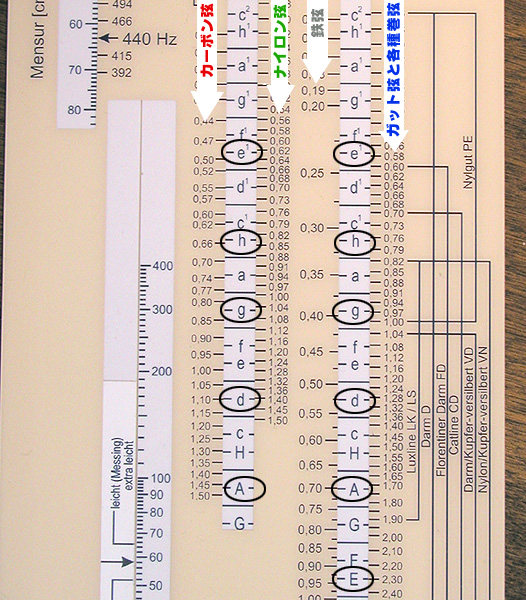
As you can see in the following photo, 2nd string (b=h) would
be 0.66mm in fluorocarbon, 0.85mm in nylon, or 0.76mm in gut.
How metal wound string should be selected, then? When you are
choosing 5th (A) string, for example, the thickness of the string
would be 1.45 mm in fluorocarbon and 1.70 mm for gut. Kuerschner uses
an equivalent gut thickness in hundredth of mm as a part of product
number of the metal wound string. There is a few candidate that is
equivalent to a gut string of 1.70mm thickness. On the right side of
this slide rule, VD, VN, etc. are printed to indicate the range of
these products. For example, if you want to use silver plated wire
wound over nylon on this guitar, the length code has to be used is
"5". So, you should order
VN5170.
It's common to use string(s) on the 1st course in higher tension
than others on lute, 19th century guitar, and modern guitar. When 5.8
kg tension is used on the 1st string like the example above, the
tension of the other strings should be around 5.2 kg instead of 5.8
kg (or that's what I would do). Of course, this depends on the type
and structure of the instrument and personal preferences on sound and
playability. Keep in mind, though, not to use too high a tension.
It's not right that higher tension always guarantee volume and
projection. Strings have to be used in tension properly matched to
the instruments to get the best result.
Have you master how to use the string slide rule, yet?
Addendum 1: In the procedure
(3), it is also possible to find the string tension with a fixed
string thickness. So, you can calculate how much tension a string is
under, by using this slide rule and a micrometer.
Addendum 2: By the way, there is
a few other features on the back side of the slide rule. "graduation
tension" is one of them and a setting of string tension which
decreases as the course number becomes larger.
Addendum 3: As I mentioned in
the other chapters, appropriate strings may differ even for
instruments with the same scale length, depending on their bracing
scheme, string bending angle at saddle, etc. The best way is to
actually try ones on the instrument with different selection
criteria.
Addendum 4: Knowing the
character of the strings you usually use is very important, because
they can serve as a good reference for changing strings. For example,
you want to change tension a little lighter (or harder) or to change
from nylon to fluorocarbon. Or you want to change a tension a little
after switching to gut string, etc. With this string slide rule,
experimenting on strings will gets much easier. You now can explore
not only sound of the instrument, but also sustain, projection,
balancing all the strings, volume adjustment, etc, etc.
Addendum 5: If you own a 19th
century guitar, it's a must to try a set of gut strings. That will
open a new horizon on your experiences of guitar music.
Addendum 6: The length code of
Kuerschner's string is the following,
0 = 60cm 1 = 90cm 2 = 120cm
3 = 180cm 5 = 115cm 6 =
150cm
Addendum 7: The material used in
Kuerschner's string are given in codes shown below,
D: Plain Gut DL: Varnished Gut NR: Rectified Nylon
PVF: Fluorocarbon PE: NylGut(Polyester) LK: Luxline
VN: Nylon& Silver Plated Copper VNG: Nylon& Silver Plated
Copper (Higher tension)
Addendum : Kuerschner restarted
to produce their string slide rule in spring of 2002, but the earlier
lot products were found to have a tension scale arrow slightly
misplaced (products shipped after June 2002 had been corrected of
this problem). If you got this slide rule through the Crane site, the
explanation and correction label has been mailed already. You can
find how to correct this in this site.
return to index
