
 How to use string
slide rule (#1)
How to use string
slide rule (#1)
|
|
 Scale length, standard
pitch, and tension are the important parameter.
Scale length, standard
pitch, and tension are the important parameter.You can find how to use a string slide rule below. This is a very deep subject, so you have to dig deep into your brain and read carefully.
The way to use a slide rule are quite similar on Pyramid's and Kuerschner's. I will start explaining how to use Pyramid's one first. Fortunately, this has an instruction in three languages on the back side. They are German, English and French, so Pyramid's is relatively easy to try, I hope.
As you can see in the photo, the slide rule is a white plastic sheet, inserted with narrow and wide rules. On the main body, there is many printed scales. You can choose appropriate strings of any material (nylon, fluorocarbon, gut, or metal wound), any scale length, and any tension. This gotta be a good stuff.
What is the difference between Pyramid's slide rule and Kuerschner's then, you may ask. The difference is the resulting products the slide rule will give. Especially on the wire wound strings, each uses their own company's product numbers. They both use basically the same principle, but they indicate different strings to be used. Although, I usually use fishing lines for nylon and fluorocarbon strings.
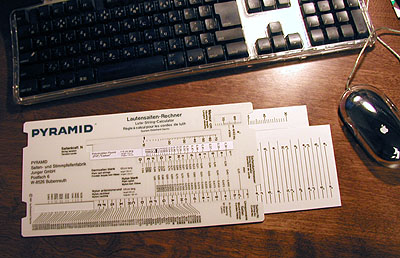
(1) Put the slide rule in portrait, namely in the position where the narrow rule can be pulled out from top.
First, determine the standard pitch, namely what frequency tone "A" should be. Then, take three deep breath.
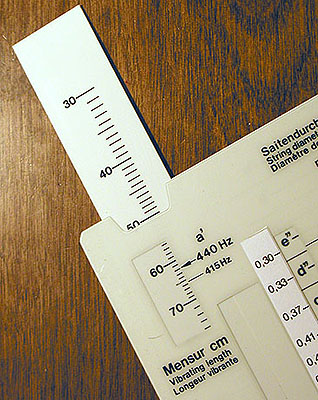
Here, I will take a typical value of A=440 Hz. The word "Mensur" printed on top left means scale length of an instrument. For example, if you are using 19th century guitar with a scale length of 62 cm, move the narrow scale to make an arrow at 440Hz point the scale length of 62 (cm), as shown in the photo.
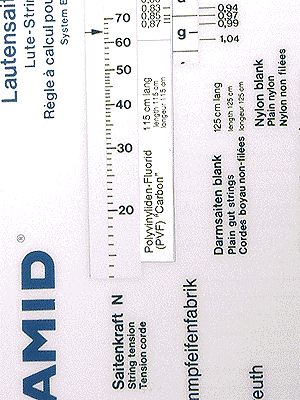
(2) Decide the tension you want to use in an unit of Newton (1kg =
2.2lb = 9.8N). Move the wide rule to match the proper tension value,
while keeping the narrow one in the same place. For example, if you
want to use a tension of 6.5kg (14lb), adjust the wide rule to align
64 on the scale to the arrow for the tension. This also is shown in
the photo below.
(3) Let's find the 1st sting, first. Only thing you have to do is to
read the scale without moving two rules on it. For example, 1st
string of guitar is expressed like e' or e1 in an
absolute tone scale. So, take a look at e' on the scale. You
may notice that there is numbers written on the both side of the
scale and wonder which side should be used. In this slide rule, you
should use one number or the other depending on the material of the
string you are planning to use.
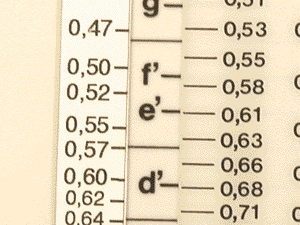
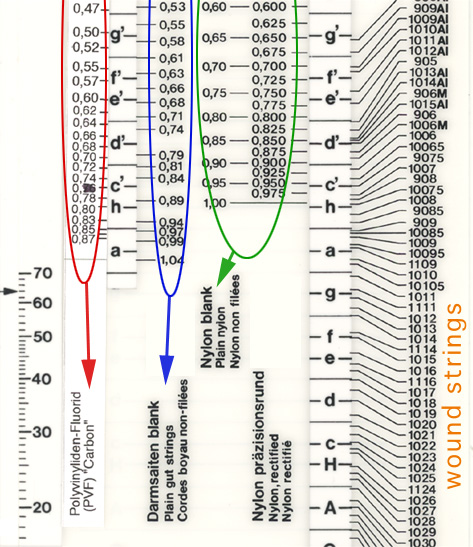
As you can see in a photo below, an e' string thickness in
6.5kg tension can be found for different material
(fluorocarbon, gut, nylon, and metal wound from left to right). The
thicknesses it indicates are 0.54mm for
fluorocarbon, 0.61mm for
gut, and 0.675mm for
nylon. There is even metal wound strings shown in further
right, so you can try
909Al metal wound, if you can come up with
one. In case there is no exact string matched for a tone, one that is
the closest should be used. On the right end of the slide rule shows
Pyramid product numbers of metal wound strings.
Darmsaiten: gut
PVF: fluorocarbon ("Seager" etc.) : paper scale pasted on top
:-)
Nylon: nylon
Repeat the same procedure, (2) - (3), on the other strings to get the
thicknesses. You can find tone names in the reference section of this
corner. In case of an usual guitar tuning, the following are the
tones for each string,
2nd(b=h),3rd(g),4th(d),5th(A),6th(E)
It's very common to use string(s) on the 1st course in higher
tension than others on lute, 19th century guitar, and modern guitar.
When the 1st string is used with 6.5 kg tension like the example
above, that for the other strings should be around 5.8 kg (or that's
what I would do). Of course, this depends on the type and structure
of the instrument and personal preferences on sound and playability.
Keep in mind, though, not to use too high a tension. It's wrong to
think higher tension always guarantee more volume and projection.
Strings have to be used in tension properly matched to the instrument
to get the best result.
Have you master how to use the string slide rule, yet?
Addendum 1: In the procedure
(3), it is also possible to find the string tension with a fixed
string thickness. So, you can calculate how much tension a string is
under, by using this slide rule and a micrometer. You can find a
tension of between 1 and 7 kg, using Pyramid's slide rule.
Addendum 2: By the way, there is
a few other features on the back side of the slide rule. "graduation
tension" is one of them and a setting of string tension which
decreases as the course number becomes larger.
Addendum 3: As I mentioned in
the other chapters, appropriate strings may differ even for
instruments with the same scale length, depending on their bracing
scheme, string bending angle at saddle, etc. The best way is to
actually try ones on the instrument with different selection
criteria.
Addendum 4: Knowing the
character of the strings you usually use is very important, because
they can serve as a good reference for changing strings. For example,
you want to change tension a little lighter (or harder) or to change
from nylon to fluorocarbon. Or you want to change a tension a little
after switching to gut string, etc. With this string slide rule,
experimenting on strings will gets much easier. You now can explore
not only sound of the instrument, but also sustain, projection,
balancing all the strings, volume adjustment, etc, etc.
Addendum 5: If you own a 19th
century guitar, it's a must to try a set of gut strings. That will
open a new horizon on your guitar music experiences.
The first in the world! A web page that explains every details on the string slide rule!
How wonderfully useful the Crane web site is!
The next Nobel prize on strings will be mine!
.... Well, I kept saying this for a last few years, but I have not heard anything from the Nobel committee. ....
return to index
